

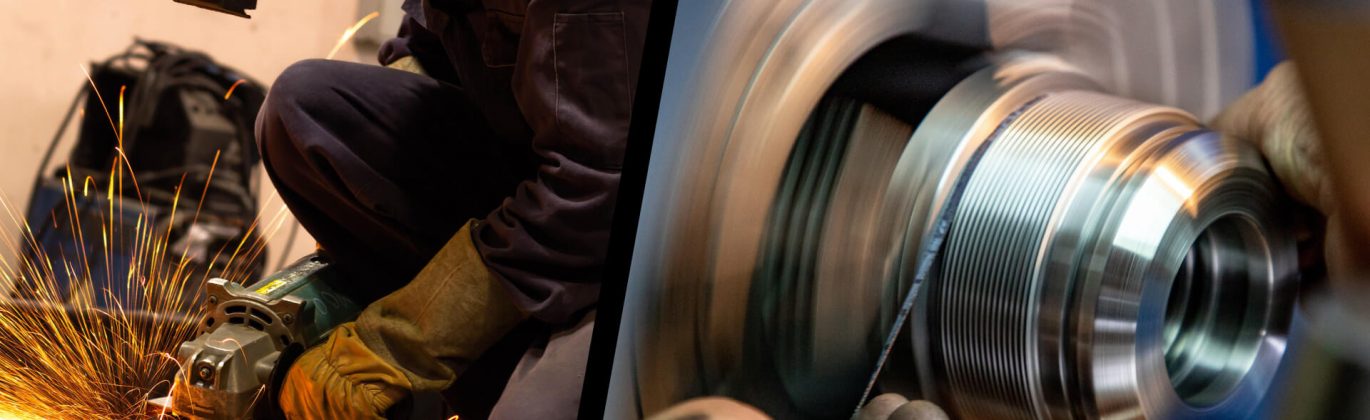
It is a pattern we see all the time: a customer reaches out asking, “Do you handle machining?” only for us to realize mid-conversation that their project is almost entirely fabrication, or the reverse.
Nobody is wrong here. Outside a working shop, the terms get used interchangeably. The difference only starts to matter once someone actually has to cut metal.
Here is where the line is drawn, in plain terms, along with four questions you can answer on your own before reaching out to a shop.
Fabrication builds a part up
Fabrication starts with plate, sheet, angle, tube, and structural stock. We cut it to size, form it, fit it together, and weld it into an assembly.
Think frames, brackets, guards, chutes, hoppers, platforms, tanks, mounts. Anything that carries load, spans a distance, encloses something, or holds other components in position. The finished part is made of several pieces joined together, and the tolerances that matter are usually measured in fractions of an inch.
Machining cuts a part down
Machining starts with a solid piece of material and removes what is not the part. On a mill, the cutter moves across the work. On a lathe, the work spins against the tool.
Think bushings, shafts, bores, keyways, threads, flanges, seats, pins, spacers. Anything that has to fit, slide, rotate, seal, or land on another surface at a specific dimension. It usually comes out as one piece, and the tolerances are measured in thousandths. Our mills and lathes routinely hold half a thousandth of an inch, or ±0.0005″, which is roughly a sixth the thickness of a sheet of paper.
How to tell which process you need: 4 questions
1. Does the part carry load, span a distance, or form a larger structure?
Structural work is fabrication. If the job is to hold weight, resist bending, or bridge a gap, it gets built from stock and welded.
2. Does it seat, slide, rotate, seal, or locate against another component?
That is machining. Anywhere two parts have to meet at a specific dimension, somebody has to cut that surface, and you cannot weld your way to it.
3. Is the tolerance measured in thousandths?
If a drawing or a spec calls out decimals to three or four places, that feature is machined. If the number is a fraction, fabrication will hold it.
4. Is it one piece or several joined together?
One solid piece points to machining. An assembly of parts points to fabrication. This is the fastest tell, and it is usually the one people can answer without looking anything up.
Most real jobs are both
Here is what the four questions do not capture: most parts that come through our door need both.
A fabricated assembly with machined bushings. A welded frame with bores that have to line up. A hopper with a flanged outlet that seals. The body of the part is fabrication. The two or three surfaces that actually have to fit are machining. The part is not one or the other. It is a fabrication with machined features, and pricing it as either alone gets it wrong.
Why one shop matters, and it is not convenience
The usual pitch for a shop with both capabilities is that you make one call instead of two. That is true, and it is the least important reason.
The real reason is sequencing. Welding moves metal. Heat goes in, the material expands and contracts as it cools, and the assembly ends up slightly different than it was when you tacked it. That is normal and expected. It is also why critical bores, mating surfaces, and other close-tolerance features get machined after the welding is done, not before.
Split that across two vendors and the sequence usually breaks. The machine shop cuts the bores to print, the fab shop welds the frame, the welding pulls the bores out of position, and the part shows up not fitting. Now you are paying someone to fix it, and each vendor can point at the other.
We see the results of that split regularly, because repair work is a large part of what we do. When fabrication and machining happen under one roof, the order of operations gets planned in AutoCAD before anything is cut, and the surfaces that have to be right get cut last.
Why we will tell you straight
A shop that only machines has a reason to call your job machining. A shop that only fabricates has the same incentive pointing the other way. That is not dishonesty, it is just what happens when the answer has to fit the equipment already on the floor.
We run both, so the recommendation is not shaped by which one we would rather sell. Sometimes the honest answer is that your part is simpler than you think and needs a piece of plate and four welds. Sometimes it is that the bracket is fine and the only real work is one machined bore. Either way you get the actual answer.
Send us the part details
You do not need to know which one it is. That is our job. Send photos, a rough sketch or a drawing if you have one, the material if you know it, and what the part has to do.
Send your part details to Thompson Repairs, and we will tell you which approach fits.
Call (904) 384-5175 or request a quote. We are on Dignan Street in Jacksonville, running mills, lathes, and welding equipment under one roof since 1988. If material choice is the open question, our post on carbon steel, stainless, and aluminum covers that side.