

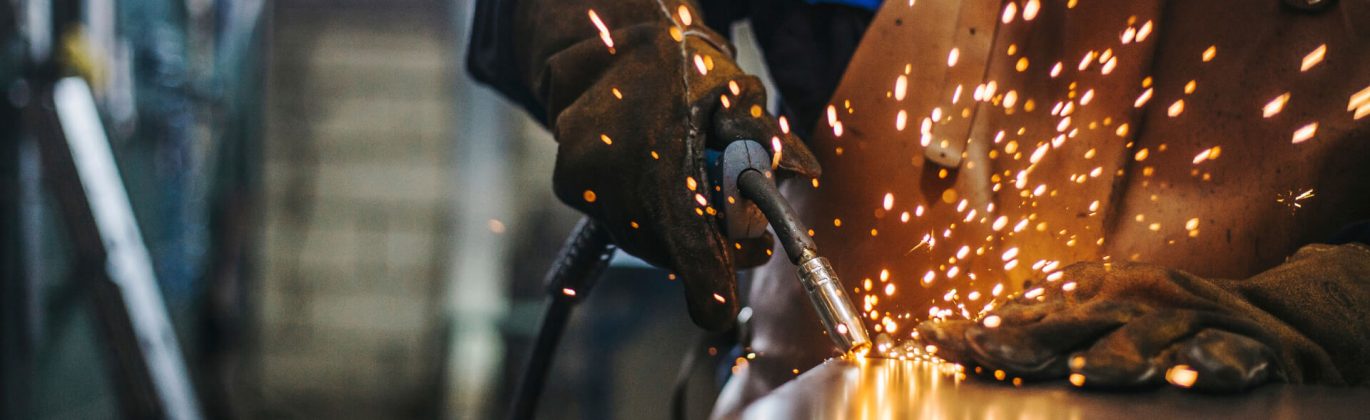
When we say we match the welding process to the project, it is not just marketing speak. The choice is not a preference. It is decided by the part, and getting it wrong costs you later.
What each process does best
MIG feeds a continuous wire while shielding the weld with gas from a bottle. It is fast, it lays down a lot of material, and it holds up well over long production runs. On carbon steel inside a shop, MIG is usually the answer.
TIG is slow, precise, and highly controlled. Because the torch and the filler rod are separate, the welder controls heat input and material deposit independently. That level of control is what you want on thin gauge material, stainless, aluminum, or anywhere a weld needs to stay visually clean. It costs more per inch, and sometimes it is the only way to get the job done right.
Stick carries its shielding in the flux coating on the electrode rather than relying on a gas bottle. It is messier, but it tolerates conditions the other two will not: wind, rust, mill scale, paint, awkward angles, and equipment that cannot be moved.
Why stick belongs outside, and MIG belongs inside
This basic difference explains most of the field versus shop divide.
MIG relies on a steady curtain of shielding gas to keep air away from the molten weld pool. Indoors, that works. Outdoors, even a light breeze blows the gas away. Air gets into the weld, and you get porosity: gas pockets through the metal that can look fine on the surface while compromising the strength of the joint.
Stick does not have that problem. Its shielding comes directly from the flux burning off the electrode, so there is no gas curtain for the wind to carry off. That is why stick has survived every attempt to replace it with newer technology, and why it is still the right call for a field repair on a windy afternoon.
What the wrong choice costs you
We routinely see three failures traceable to process selection rather than to the welder:
-
Weak penetration on heavy sections.
A process set up for thin material applied to heavy plate can create a weld that looks finished on top while barely fusing to the base metal underneath. It holds for a while, then fails under real load. -
Distortion and burn-through on thin material.
Too much heat into light gauge and the part warps or blows through. On a fabricated assembly, that distortion pulls dimensions out of alignment, and any surface that was machined to fit no longer does. -
Cracking under cyclical load.
The hardest to catch, because the part passes visual inspection and works. Then after thousands of load cycles, a weld with the wrong profile or heat history develops a crack at the toe. Vibrating or flexing equipment punishes this specifically.
A fourth shows up in coastal environments. Stainless welded without heat control, and without cleaning the discoloration afterward, pits and corrodes in salt air even when the weld itself is sound.
Five factors that decide the process
- Material. Carbon steel, stainless, and aluminum behave differently and take different processes
- Thickness. The single biggest driver. Heat levels right for quarter-inch plate destroy sixteen-gauge sheet
- Position. Flat and horizontal give you options. Overhead and vertical narrow them quickly
- Load type. Static loads are forgiving. Cyclical and shock loads are not, and they drive both the process and the joint design
- Environment. Indoors or out, clean or contaminated, on a bench or fixed in place
Change any single variable and the correct process can change with it. That is why the decision happens alongside joint design in AutoCAD, long before any metal is cut.
Where choice stops being a judgment call
Some welding applications are not a choice at all. Structural steel, pressure vessels, and anything requiring official sign-off fall under building codes or customer specifications. Those documents name the process, the filler, the joint geometry, and the welder qualifications required, and nothing in this article overrides them.
If your part falls under a code or an engineered drawing, tell us at the start. Identifying those constraints up front is cheaper than finding out later.
Field repairs and shop builds are different problems
A field repair solves an immediate problem. Equipment is down, it cannot be moved, and conditions are whatever they are. The goal is getting back up and running. Stick usually wins because it tolerates those realities.
A shop build solves for the long haul. The part rests on a clean table, the position is controlled, the material is prepped, and the process gets chosen purely on merit.
Both are valid. Confusing the two is the mistake. A field repair that was correct at the time is still a temporary fix, and when that part eventually arrives at our shop, the right answer is often to cut out the temporary joint and rebuild it properly.
We see the shop end of that regularly, because repair work and new builds run through the same floor. A weld that failed tells us as much as a drawing does.
Versatility is the whole point
Custom mounts for service trucks. Transport carts for professional athletes. Roll-off dumpsters, silo gates, one-off replacement components. Those jobs have almost nothing in common, and they do not get welded the same way. Keeping MIG, TIG, and stick under one roof means the process is matched to your part, rather than forcing your part to fit whatever machine we happen to have turned on.
Talk with our team about the right approach for your next welding project.
Call (904) 384-5175 or request a quote online. We are located on Dignan Street in Jacksonville and have provided industrial welding services for over thirty years.
General guidance based on our experience. Process selection for a specific part depends on its material, service conditions, and any governing code or customer specification.